You’ve started topping up the water bowl more often than you used to. Your senior cat seems hungrier but somehow thinner. Your old dog is still eating, still greeting you at the door, still very much themselves. Nothing is obviously wrong, and that is exactly the problem.
The diseases that most often shorten a senior pet’s life are the ones happening quietly on the inside. Kidney, thyroid, liver and heart conditions rarely announce themselves. They build slowly, and by the time you can see something is wrong, a great deal of damage has usually already been done.
At Wagga Wagga Veterinary Hospital, we’ve spent over 60 years caring for senior pets across Wagga, Kooringal, Lake Albert, and the wider Riverina. Internal organ disease is one of the most important things we screen for in our Golden Oldies, because it is also the easiest thing to miss at home. Here’s what’s worth knowing.
Why Internal Disease Stays Hidden
Organs have remarkable reserve capacity. The kidneys, for example, can lose a large share of their working tissue before a pet shows a single outward sign. Your pet compensates, adapts, and carries on looking fine.
On top of that, dogs and cats instinctively conceal illness, and the early signs that do appear are easy to attribute to age. Drinking a bit more, sleeping a bit longer, slowing down slightly. These read as an old pet being an old pet. Often they are. Sometimes they are the first sign of something we can treat.
Kidney Disease: The Big One for Senior Cats
Chronic kidney disease is one of the most common conditions we see in older cats, affecting an estimated 30 to 40 per cent of cats over ten years of age. It occurs in dogs too, though less frequently.
The difficulty is timing. Traditional kidney testing relies on creatinine, which typically does not rise above the normal range until around 75 per cent of kidney function has already been lost. By that point, treatment is largely about slowing the decline rather than getting ahead of it.
A newer blood marker called SDMA has changed this considerably. SDMA can flag reduced kidney function once roughly 25 to 40 per cent has been lost, and in cats it has been shown to detect disease an average of well over a year earlier than creatinine alone. That earlier window is where diet changes, blood pressure management and monitoring can genuinely add comfortable years.
Early kidney disease has no reliable symptoms, so the only way to catch it in that window is to test for it.
Thyroid Disease: Two Different Problems
Thyroid disease works in opposite directions in cats and dogs, which is worth understanding.
In cats, an overactive thyroid, or hyperthyroidism, is the most common hormonal disorder of older age and affects more than ten per cent of cats over ten years. The classic picture is a cat losing weight despite a healthy or increased appetite, sometimes with restlessness, vomiting or increased thirst. Owners occasionally describe their cat as seeming younger and more energetic, which makes it easy to miss. Left untreated, it puts real strain on the heart and blood pressure.
In dogs, an underactive thyroid, or hypothyroidism, is more common. It tends to look like the reverse: weight gain without overeating, lethargy, a dull or thinning coat, and recurring skin problems.
Both are diagnosed with a straightforward blood test, and both respond well to treatment. Many pets go on to live entirely normal lives once their levels are managed.
Diabetes, Liver and Heart Disease
Diabetes becomes more likely with age and with excess weight, and is more commonly seen in cats, affecting roughly one in every 150 to 200 cats in Australia. The signs to know are increased thirst, increased urination, weight loss despite a good appetite, and lethargy. Caught early, many pets are well managed with insulin and diet, and some cats improve significantly with the right nutrition.
Liver disease is often picked up on blood work before an owner notices anything at all. When signs do appear, they can include reduced appetite, vomiting, lethargy, or yellowing of the gums and eyes.
Heart disease is common in older pets and, again, quiet in its early stages. Coughing, tiring quickly on walks, increased breathing rate at rest, or reluctance to exercise are all worth raising with us. In cats particularly, heart disease can progress a long way with no outward sign at all.
These conditions also interact. An untreated overactive thyroid strains the heart. Diabetes affects the liver. Kidney disease drives blood pressure up. Managing one well often protects the others.
Signs Worth a Phone Call
Book a check if you notice any of the following in your senior pet:
- Drinking noticeably more, or more frequent urination
- Weight loss, even with a normal or increased appetite
- Weight gain without an increase in food
- Reduced appetite, or vomiting more than occasionally
- Lethargy, or tiring more easily than usual
- Coughing, or faster breathing while resting
- A dull, thinning or unkempt coat
- Yellowing of the gums, eyes or skin
Individually these are easy to shrug off. Together, or persisting for more than a week or two, they are worth a conversation.
What a Senior Health Screen Involves
A senior wellness visit starts with a thorough physical examination, including listening to the heart and lungs and feeling the abdomen for organ changes. From there we recommend blood and urine testing, which is where most internal disease is actually found.
A full geriatric panel typically covers a complete blood count, biochemistry to assess kidney and liver function and blood glucose, thyroid testing, and urinalysis. Urine testing matters more than people expect, as the kidneys’ ability to concentrate urine is one of the earliest functions to slip. We often check blood pressure as well, particularly in cats.
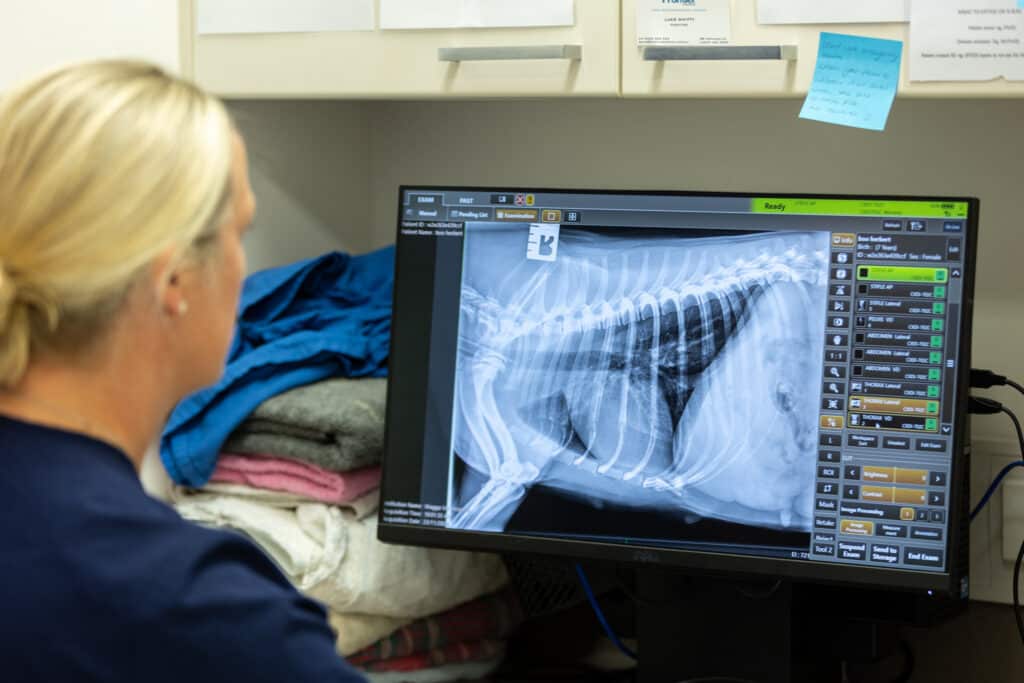
Because we have an in-house laboratory, most results come back within hours rather than days, so we can talk through what we’ve found and agree a plan while you’re still thinking about it. Where we need a closer look, our ultrasound and X-ray capabilities let us image the organs directly, right here in Wagga.
For a healthy senior pet, we recommend screening every six months. In pet years that is a meaningful stretch of time, and it is often enough to catch something in the window where it still matters.

The Test That Finds Nothing Is Still a Good Result
Screening a senior pet who turns out to be perfectly healthy is not a wasted visit. It gives us baseline values, and baselines are what make next year’s results meaningful. A result that sits at the top of the normal range means little on its own, but next to last year’s numbers it can tell us a great deal.
Whether your senior dog or cat lives in Kooringal, Lake Albert, Turvey Park, or anywhere across Wagga and the Riverina, our experienced team is here to help you stay ahead of what you can’t see.
Noticed your senior pet drinking more, losing weight, or slowing down? Our Golden Oldies senior pet care approach includes full internal health screening as part of looking after your ageing companion.
Call (02) 6926 0900 to book. Available 24/7 for emergencies.
Locations: 132 Urana Street, Wagga Wagga | 140 Broadway Street, Junee